Call us today on 01297 692 200 to find out how BGA Accountants can help you!


Blog
Latest Blog & Articles
Stay informed with expert financial insights! Explore our latest blogs on wealth management, retirement planning, and smart investment strategies. Empower your financial future with practical tips and expert advice.
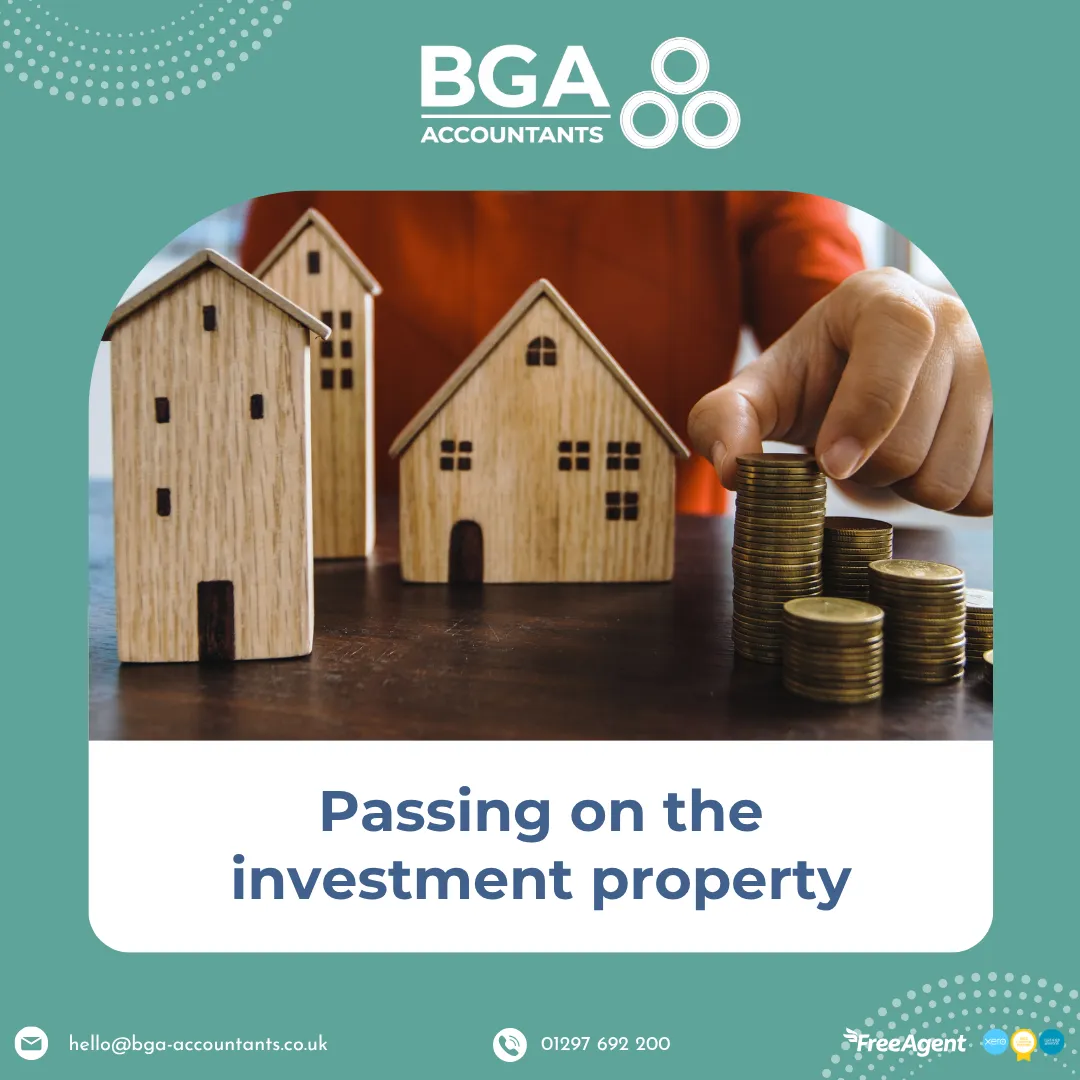
Passing on the investment property
A landlord will need to consider whether it is better to pass on an investment property during their lifetime or on their death. Here, we look at the associated tax implications.
On death
Where a landlord dies, any investment properties that they have will form part of their estate at death and, unless they are sheltered by the nil rate band, inheritance tax (IHT) will be payable at the rate of 40%.
However, there will be no capital gains tax to pay. The property benefits from a tax-free uplift at death and the beneficiary’s base cost will be the market value of the property at the date of death.
The maximum exposure here is 40% of the value at the date of death.
Gifting the investment property
In a bid to avoid a hefty IHT charge, landlords may decide it is better to give their investment property to their children while they are still alive. However, if the property has increased in value since they purchased it, this will trigger a capital gains tax charge, even though the landlord does not receive any proceeds. This is because where an asset is gifted to a connected person (such as a child), the capital gain will be worked out using the market value at the date of the gift. Any gain not sheltered by the annual exempt amount (£3,000 for 2026/27) or by losses will be taxed at 18% where the landlord’s income and gains fall in the basic rate band (£37,700 for 2026/27) and at 24% once the basic rate band has been used up.
If the property is a residential property in the UK, the gain must be reported to HMRC within 60 days of completion and the capital gains tax paid within the same time frame.
If the landlord does not have sufficient funds elsewhere to meet the capital gains tax liability, consideration could be given to selling the property to the child for an amount equal to the capital gains tax. Although there will be some consideration here, the gain is still worked out by reference to the market value as the connected person rules apply.
The child’s base cost for capital gains tax purposes is the market value of the property.
If the landlord lives for at least seven years after the date of the gift, it falls out of the estate for IHT purposes. Here the landlord will have paid capital gains tax at a maximum of 24%, whereas if the property had been passed on at death, IHT would have been payable at the rate of 40%.
If the landlord does not survive seven years, IHT will be payable. Taper relief applies to reduce the rate of IHT on the gift (where it is not sheltered by the nil rate band) if the landlord lives for at least three years from the date of the gift. However, if the landlord dies within five years of making the gift, the combined capital gains tax and IHT tax hit will be more than 40%. The maximum exposure is 64% if the person gives away the property paying capital gains tax at 24% and then dies within three years, triggering an IHT bill of 40%.
Beware the GWR rules
If the property continues to be rented out after it has been given away, it is important that the former landlord does not continue to receive the rental income as this will render the gift ineffective for IHT purposes under the gifts with reservation (GWR), rules meaning it will be included in the death estate and liable to IHT.

The BGA Difference
Simple, Honest Advice — With No Surprises
We work on fixed monthly fees, with unlimited calls and meetings included — so you can ask questions anytime, without worrying about the cost.
Your first meeting and initial advice are always free.
We speak plain English, not accountancy jargon. You shouldn’t need a finance degree to understand your own numbers — and we’ll explain everything clearly so you feel confident, not confused.
We’ve seen it time and again: when clients understand their accounts and taxes, they make better decisions. That’s why we focus on accessible advice, regular check-ins, and smart tax planning throughout the year.
We're not the cheapest Accountant around and we don't want to be! We provide a reliable, quality service at a fair price.
Contact
Opening hours
Monday - Thursday : 9:00AM - 5PM

Helping you achieve financial success with expert guidance and personalised strategies.

© BGA Accountants. 2026. All Rights Reserved.
PRIVACY POLICY | SUPPORT | TERMS & CONDITION