Call us today on 01297 692 200 to find out how BGA Accountants can help you!

Blog
Latest Blog & Articles
Stay informed with expert financial insights! Explore our latest blogs on wealth management, retirement planning, and smart investment strategies. Empower your financial future with practical tips and expert advice.
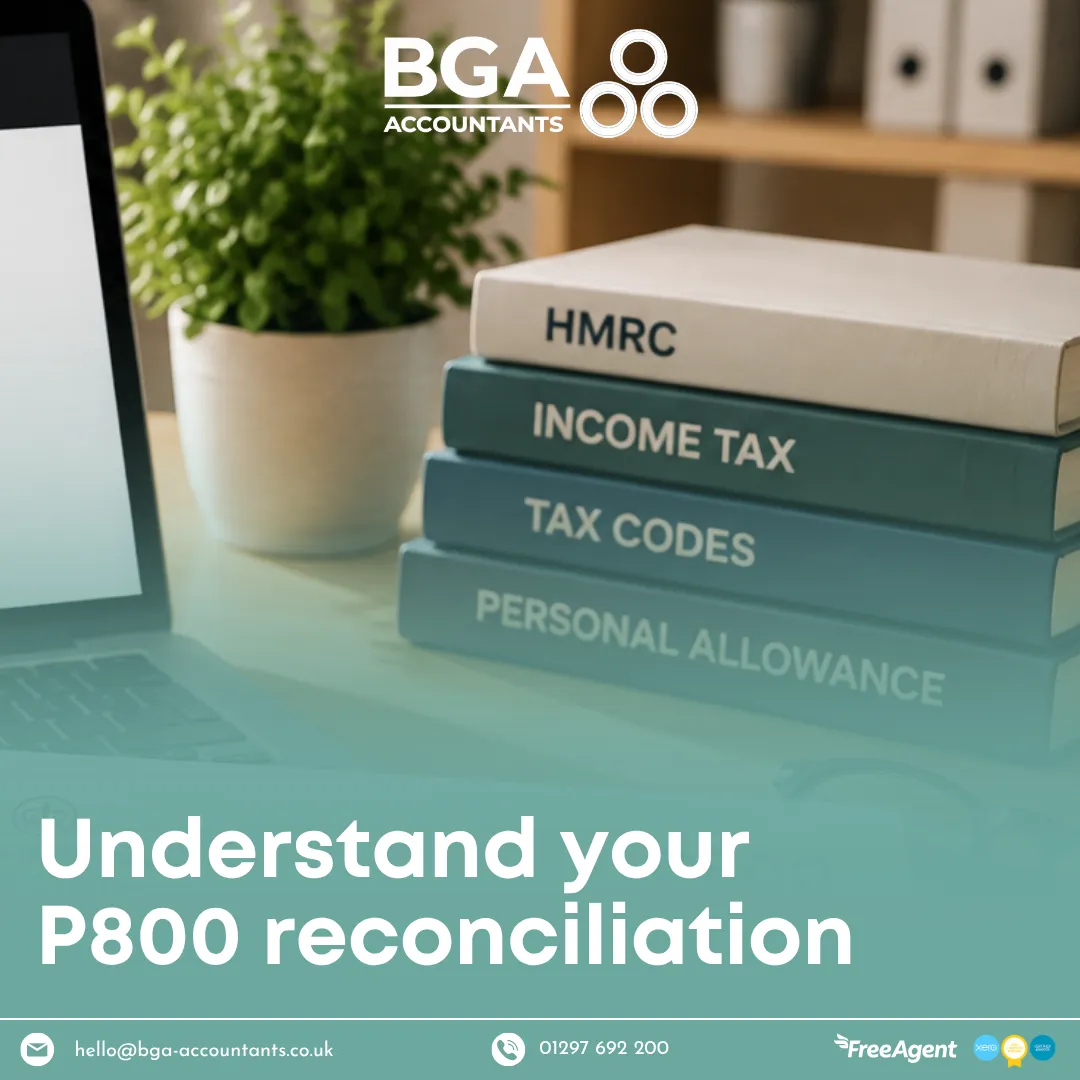
Understand your P800 reconciliation
HMRC send out a P800 tax calculation letter where a person who is employed and/or in receipt of a pension has overpaid or underpaid tax. They will not get a letter if they complete a Self-Assessment tax return instead; their Self-Assessment bill will be adjusted automatically.
There are various reasons why a person may receive a letter, for example, because they were on the wrong tax code, they finished one job and started another in the same tax month, they started receiving a pension while they were still working or they received Employment and Support Allowance or Jobseeker’s Allowance. They may owe tax or be due a tax refund as a result.
Claiming a refund
Where the taxpayer is due a tax refund, the P800 letter will explain how to claim that refund. Where the letter states that the refund can be claimed online, the taxpayer can make the claim by visiting the Gov.uk website at www.gov.uk/tax-overpayments-and-underpayments/if-youre-due-a-refund.
Claims can also be made through the taxpayer’s personal tax account or the HMRC app or by contacting HMRC. Where a claim is made online, the refund should be received in five working days.
If the tax calculation letter states that the taxpayer will get a cheque, they do not need to do anything – the cheque will normally be received within 14 days of the date on the P800 letter.
Owing tax
If the P800 tax calculation letter says that the taxpayer owes tax, HMRC will usually collect this by amending the taxpayer’s tax code so as to collect the tax that is owed from the taxpayer’s wages in 12 equal instalments. This will happen automatically where the taxpayer pays tax under PAYE on employment income or a pension, their income exceeds their personal allowance by a sufficient amount to collect the tax due and the amount owed is less than £3,000.
If the tax cannot be collected in this way, HMRC will write to the taxpayer.
Check the calculation
It is dangerous to simply assume the tax calculation is correct – it should always be checked.
Particular problems are known to arise as regards the allocation of allowances where the taxpayer has more than one source of income. Under current rules, allowances should be allocated so as to give the best outcome. However, in practice this does not always happen, and errors can result particularly in relation to the application of the savings nil rate band.
If you think the calculation is wrong, contact HMRC. If they agree that the calculation is incorrect, they will issue a new one. If they don’t agree, they will explain why.

The BGA Difference
Simple, Honest Advice — With No Surprises
We work on fixed monthly fees, with unlimited calls and meetings included — so you can ask questions anytime, without worrying about the cost.
Your first meeting and initial advice are always free.
We speak plain English, not accountancy jargon. You shouldn’t need a finance degree to understand your own numbers — and we’ll explain everything clearly so you feel confident, not confused.
We’ve seen it time and again: when clients understand their accounts and taxes, they make better decisions. That’s why we focus on accessible advice, regular check-ins, and smart tax planning throughout the year.
We're not the cheapest Accountant around and we don't want to be! We provide a reliable, quality service at a fair price.
Contact
Opening hours
Monday - Thursday : 9:00AM - 5PM
Helping you achieve financial success with expert guidance and personalised strategies.

© BGA Accountants. 2026. All Rights Reserved.
PRIVACY POLICY | SUPPORT | TERMS & CONDITION