Call us today on 01297 692 200 to find out how BGA Accountants can help you!


Blog
Latest Blog & Articles
Stay informed with expert financial insights! Explore our latest blogs on wealth management, retirement planning, and smart investment strategies. Empower your financial future with practical tips and expert advice.
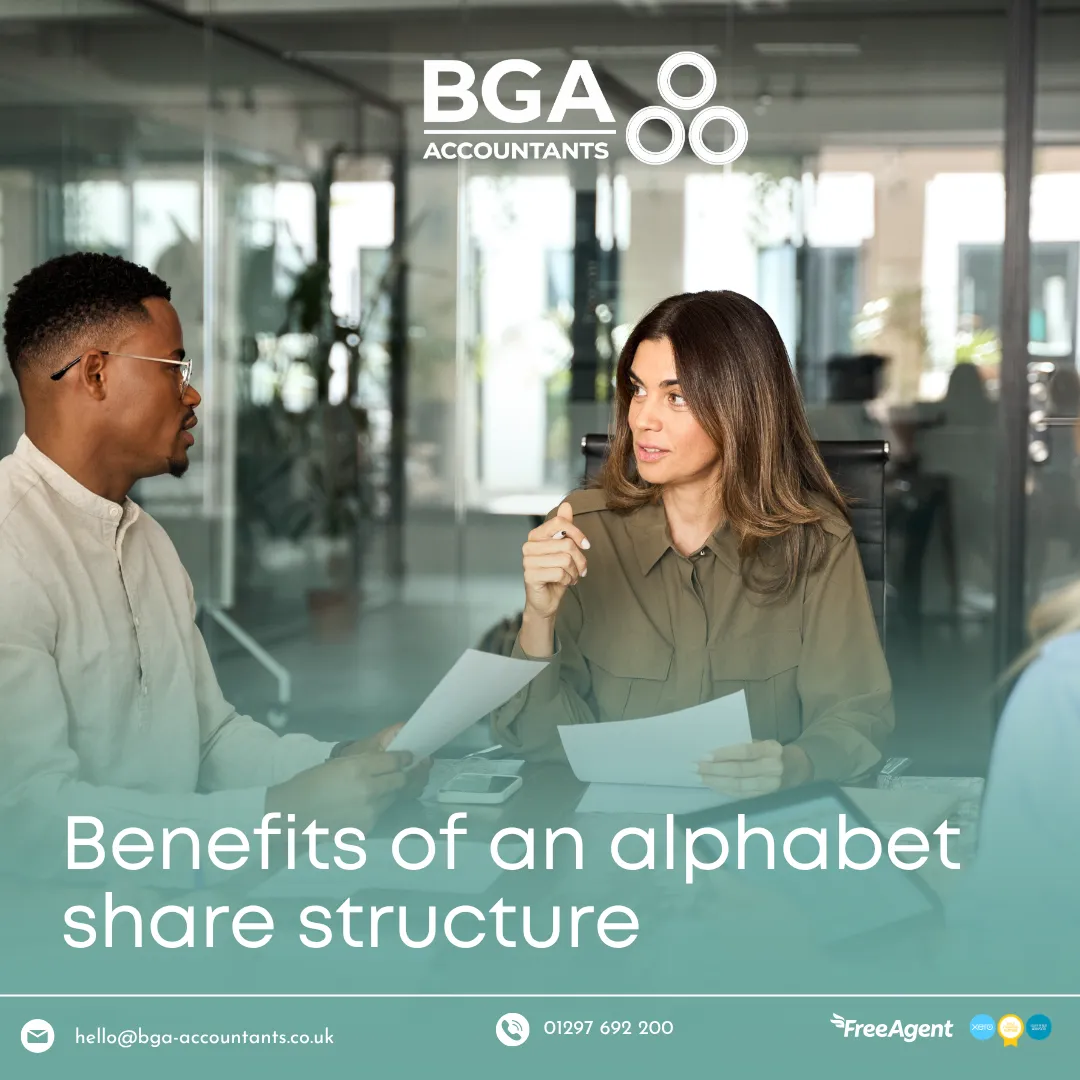
Benefits of an alphabet share structure
Where a business is operated through a limited company, profits need to be extracted if they are to be used personally. Where the personal allowance remains available, it is generally beneficial to pay a salary equal to the personal allowance and to extract any further profits needed outside the company in the form of dividends.
In a family company, there may be a number of shareholders.
Paying dividends is not as straightforward as paying a salary or a bonus as there are company law rules which must be adhered to. The first point to note is that dividends are paid from retained profits. These are profits on which corporation tax has already been paid, and which have yet to be distributed. A company can only pay a dividend if it has sufficient retained profits from which to pay it.
The second point to note is that where there is more than one shareholder for a class of share, dividends must be paid in proportion to the shareholdings, which can be very limiting and may not give a tax-efficient result. This is where an alphabet share structure comes in.
Under an alphabet share structure, each shareholder has their own class of share, for example, A ordinary shares, B ordinary shares, etc. This allows different dividends to be paid for each class of share, making it possible to tailor the dividends to the shareholder’s personal circumstances. For example, a company may tailor dividends to mop up any unused dividend allowances and basic rate bands.
Example
Albert and Anna are shareholders in A Ltd. They each own 50% of the ordinary share capital.
The company has profits of £50,000 it wishes to distribute. Neither Anna nor Albert have used their dividend allowance. Albert has no other income in 2026/27, whereas Anna has income of £200,000 from her property portfolio.
As Anna and Albert each own 50% of the shares, each will receive a dividend of £25,000. Albert can set his dividend allowance and personal allowance against his dividend so £13,070 is tax-free. The remaining £11,930 is a taxed at 10.75% – a tax bill of £1,282.47. Anna will also receive a dividend of £25,000, of which £500 is sheltered by her dividend allowance. The remaining £24,500 is taxed at 39.35% – a tax bill of £9,640.75. Their combined tax bill is £10,923.22.
If instead they had adopted an alphabet share structure whereby Albert owned one ordinary A share and Anna owned one ordinary B share, they could have tailored the dividends to their personal circumstances. Instead of each receiving a dividend of £25,000, a dividend of £49,500 could be declared for the A share and a dividend of £500 for the B share. Albert would receive a dividend of £49,500 on which tax of £3,916.25 would be payable, while Anna would receive a dividend of £500 which would be sheltered by her dividend allowance. Their combined tax bill is over £7,000 lower where an alphabet share structure is used.

The BGA Difference
Simple, Honest Advice — With No Surprises
We work on fixed monthly fees, with unlimited calls and meetings included — so you can ask questions anytime, without worrying about the cost.
Your first meeting and initial advice are always free.
We speak plain English, not accountancy jargon. You shouldn’t need a finance degree to understand your own numbers — and we’ll explain everything clearly so you feel confident, not confused.
We’ve seen it time and again: when clients understand their accounts and taxes, they make better decisions. That’s why we focus on accessible advice, regular check-ins, and smart tax planning throughout the year.
We're not the cheapest Accountant around and we don't want to be! We provide a reliable, quality service at a fair price.
Contact
Opening hours
Monday - Thursday : 9:00AM - 5PM
Helping you achieve financial success with expert guidance and personalised strategies.

© BGA Accountants. 2026. All Rights Reserved.
PRIVACY POLICY | SUPPORT | TERMS & CONDITION