Call us today on 01297 692 200 to find out how BGA Accountants can help you!

Blog
Latest Blog & Articles
Stay informed with expert financial insights! Explore our latest blogs on wealth management, retirement planning, and smart investment strategies. Empower your financial future with practical tips and expert advice.
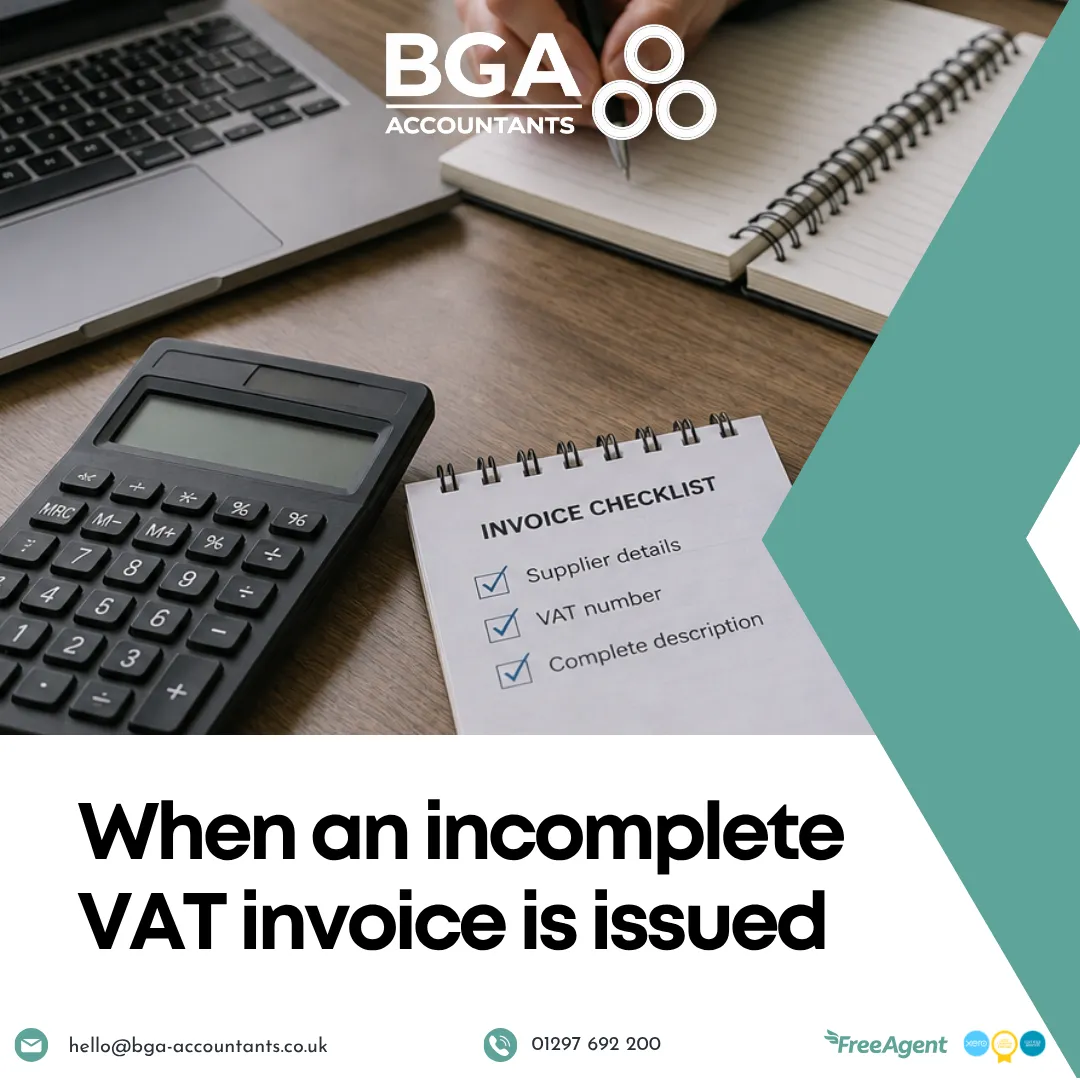
When an incomplete VAT invoice is issued
VAT-registered businesses can generally reclaim VAT on goods and services purchased for business purposes. However, for a claim to succeed HMRC requires valid evidence to support those claims. In most cases, this means retaining a valid VAT invoice, but what is the situation should a full VAT invoice not be issued?
An invalid VAT invoice
A VAT invoice must contain specific information, including the supplier’s details, a unique sequential number, the VAT registration number, invoice date, the customer’s name and address, description of goods or services supplied, the VAT rate charged, the net of VAT amount payable and total gross amount payable. A recent tax case, Athena Luxe Ltd v HMRC [2025], serves as a reminder of these requirements. However, where a fully compliant invoice cannot be obtained, all is not necessarily lost. The tax case confirmed that HMRC cannot automatically reject a VAT claim simply because a supplier has failed or refused to issue a compliant invoice if there is other convincing evidence showing that the business genuinely incurred the VAT.
Common examples of invalid invoices include those that:
omit the supplier’s VAT registration number;
fail to show the VAT amount separately;
lack sufficient detail about the goods or services supplied; or
have inaccuracies regarding dates, values or parties involved.
Crucially, where a business seeks to recover VAT, the invoice should normally be addressed to that business. Problems can arise when invoices are issued in the name of a company director, an employee or another party rather than the VAT-registered business, as the tax case showed.
Athena Luxe Ltd v HMRC [2025] UKFTT 1507 (TC)
Athena Luxe Ltd bought luxury goods from UK traders and exported them overseas. As these sales were mainly zero-rated exports, it regularly reclaimed VAT on its purchases. HMRC reviewed its VAT returns and disallowed input VAT because it said some invoices were invalid. Some invoices lacked sufficient description of the goods purchased whilst others were issued in employees’ names rather than the company’s. When asked, the issuing company refused to issue in the correct (company) name.
HMRC must consider all evidence before making its decision. Where an invoice wasdone all it could to obtain valid invoices. HMRC's refusal to exercise its discretion to accept alternative evidence was found to be unreasonable.
Note that this tax case was a First-tier Tribunal decision, so it is persuasive but not binding on all future cases.
E-invoicing
E-invoicing is likely to make the problems seen in Athena Luxe Ltd v HMRC less common. Under a typical e-invoicing system, invoice data is generated in a structured digital format rather than as a PDF or paper receipt, containing the same information as paper invoices.
From April 2029, all UK VAT‑registered businesses will be required to create, send, receive and process invoices to other businesses in a compliant electronic format. This will allow data to be read automatically by systems without manual intervention.
Although the use of e-invoicing should produce fewer defective invoices, HMRC may become less tolerant of basic invoice errors because they become easier to avoid. Disputes may focus more on the substance of the transaction.
Practical point
Where invoices contain errors, businesses should seek corrected documentation from suppliers as soon as possible. Relying on HMRC’s discretion is rarely desirable. Additional records (e.g. bank statements, expense claim records, purchase orders, contracts, email correspondence, delivery notes and receipts) can help demonstrate that a genuine business transaction took place and that VAT was properly incurred.

The BGA Difference
Simple, Honest Advice — With No Surprises
We work on fixed monthly fees, with unlimited calls and meetings included — so you can ask questions anytime, without worrying about the cost.
Your first meeting and initial advice are always free.
We speak plain English, not accountancy jargon. You shouldn’t need a finance degree to understand your own numbers — and we’ll explain everything clearly so you feel confident, not confused.
We’ve seen it time and again: when clients understand their accounts and taxes, they make better decisions. That’s why we focus on accessible advice, regular check-ins, and smart tax planning throughout the year.
We're not the cheapest Accountant around and we don't want to be! We provide a reliable, quality service at a fair price.
Contact
Opening hours
Monday - Thursday : 9:00AM - 5PM
Helping you achieve financial success with expert guidance and personalised strategies.
© BGA Accountants. 2026. All Rights Reserved.
PRIVACY POLICY | SUPPORT | TERMS & CONDITION