Call us today on 01297 692 200 to find out how BGA Accountants can help you!

Blog
Latest Blog & Articles
Stay informed with expert financial insights! Explore our latest blogs on wealth management, retirement planning, and smart investment strategies. Empower your financial future with practical tips and expert advice.
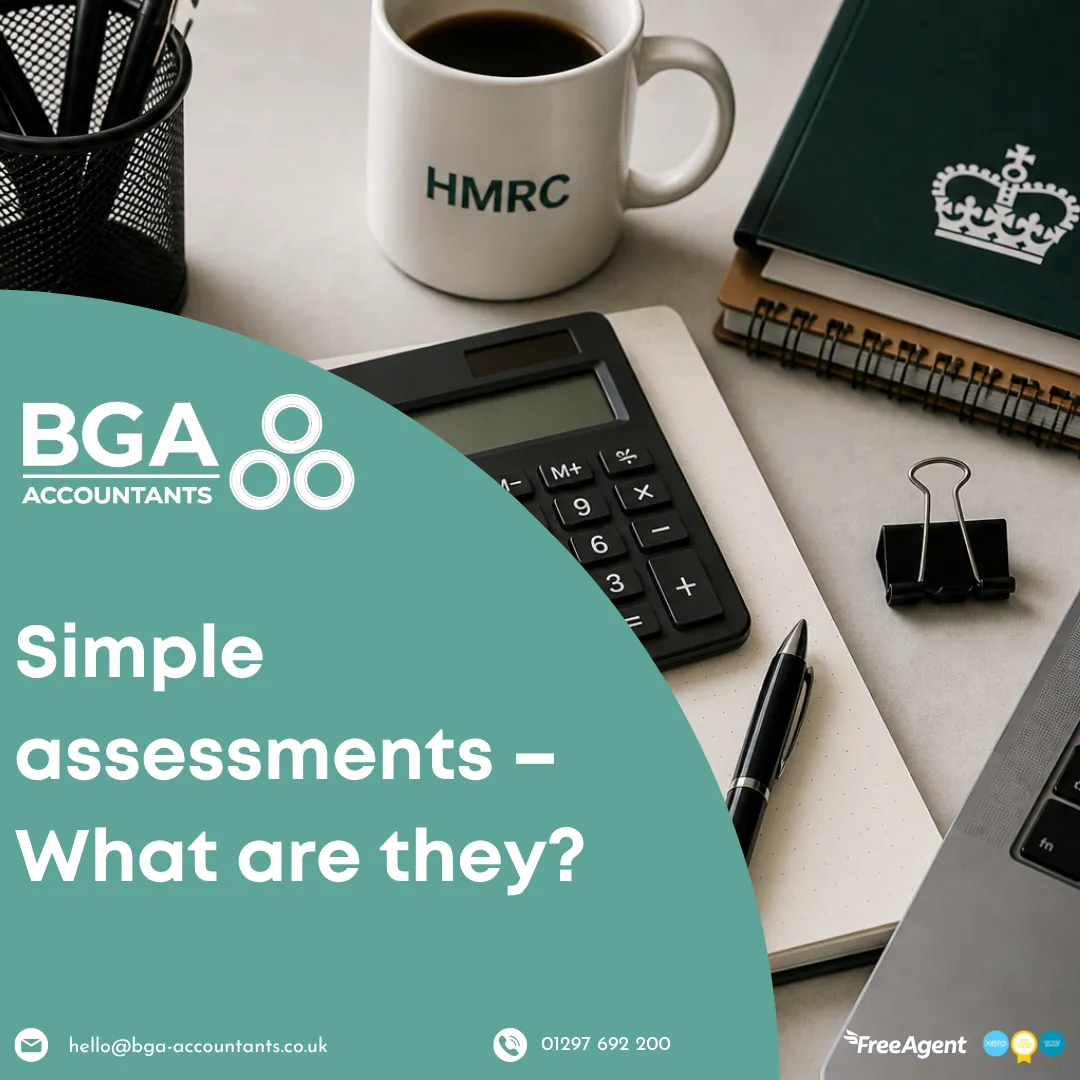
Simple assessments – What are they?
In the last few months, some taxpayers who possibly have had no dealings with HMRC previously have been receiving letters headed ‘Simple Assessment’. The letters are being sent to those taxpayers whose outstanding tax liabilities cannot be collected automatically through the Pay As You Earn (PAYE) system or who do not complete a self-assessment tax return.
A simple assessment is issued when HMRC already holds sufficient information to calculate a taxpayer’s liability, but cannot collect it automatically. Rather than requiring the individual to complete a tax return, HMRC calculates the liability and issues an assessment showing the amount due.
Therefore, such assessments are commonly issued to taxpayers that HMRC believes have:
underpaid tax from employment or pension income;
state pension income that has not been fully taxed;
multiple sources of income where PAYE deductions were insufficient;
tax liabilities of £3,000 or more that cannot be recovered through tax code adjustments; or
tax due after employment or PAYE income has ceased.
HMRC bases simple assessments on information provided by the Department for Work and Pensions, employers, pension providers and other organisations (such as banks).
How does self-assessment differ?
The main distinction between simple assessment and self-assessment is who provides the information and performs the calculation. Unlike simple assessment, where HMRC performs the calculation, self-assessment places responsibility on the taxpayer to declare all relevant income, expenses, reliefs and allowances accurately. HMRC then calculates the final liability based on the information submitted, although taxpayers can calculate themselves.
Note that taxpayers cannot choose to enter the simple assessment system – HMRC decides.
When are simple assessments issued?
HMRC generally starts issuing simple assessment calculations in the summer months following the end of the tax year. By that time, HMRC will have automatically received data from the Department for Work and Pensions and financial institutions such as banks. As information is received at different times, HMRC may issue multiple assessments for the same taxpayer.
Query and appeal
Unlike for self-assessment, there is a slightly different process for querying a simple assessment. A ‘query’ is raised where the taxpayer contacts HMRC by phone, or in writing, to explain why they disagree with the assessment. The taxpayer has 60 days from the issue of the assessment to raise a query.
If the taxpayer remains dissatisfied after HMRC has responded, they may submit a written appeal within 30 days of HMRC’s final response.
A revised simple assessment is automatically issued when a query has closed which will be when one of the following takes place:
1.when HMRC closes the query manually; or
2.six months after the query was raised.
An appeal does not have an automatic closure date.
Payment dates
Payment dates mirror self-assessment deadlines. If the assessment for the 2025/26 tax year is issued before 31 October 2026, payment must be made by 31 January 2027; if received after 31 October 2026, payment is within three months of the date on the assessment letter.
Why are (more) simple assessments being issued?
Simple assessments are not new. Although simple assessment was introduced in September 2017, its use has expanded significantly. HMRC issued a record 1.32 million simple assessments in 2023/24 tax year.
However, rising state pension payments under the ‘triple lock’ and higher savings interest are pushing more people over the frozen personal allowance, resulting in more assessments being issued.
State pension only
The so-called ‘triple lock’ guarantees that the state pension increases annually by the highest of September's consumer price index figure (which stood at 3.8% for 2025), average earnings growth between May and July, or 2.5%. As personal allowances are frozen at £12,570 until April 2031, from April 2027 someone whose only income is the full new state pension will receive more than the personal allowance, so tax would be due.
However, the Chancellor has confirmed that those people will not have to pay tax before 2030.
Practical point
As HMRC continues to expand its use of digital records and real-time reporting, more taxpayers will receive simple assessments instead of being asked to complete a full tax return.

The BGA Difference
Simple, Honest Advice — With No Surprises
We work on fixed monthly fees, with unlimited calls and meetings included — so you can ask questions anytime, without worrying about the cost.
Your first meeting and initial advice are always free.
We speak plain English, not accountancy jargon. You shouldn’t need a finance degree to understand your own numbers — and we’ll explain everything clearly so you feel confident, not confused.
We’ve seen it time and again: when clients understand their accounts and taxes, they make better decisions. That’s why we focus on accessible advice, regular check-ins, and smart tax planning throughout the year.
We're not the cheapest Accountant around and we don't want to be! We provide a reliable, quality service at a fair price.
Contact
Opening hours
Monday - Thursday : 9:00AM - 5PM
Helping you achieve financial success with expert guidance and personalised strategies.

© BGA Accountants. 2026. All Rights Reserved.
PRIVACY POLICY | SUPPORT | TERMS & CONDITION