Call us today on 01297 692 200 to find out how BGA Accountants can help you!

Blog
Latest Blog & Articles
Stay informed with expert financial insights! Explore our latest blogs on wealth management, retirement planning, and smart investment strategies. Empower your financial future with practical tips and expert advice.
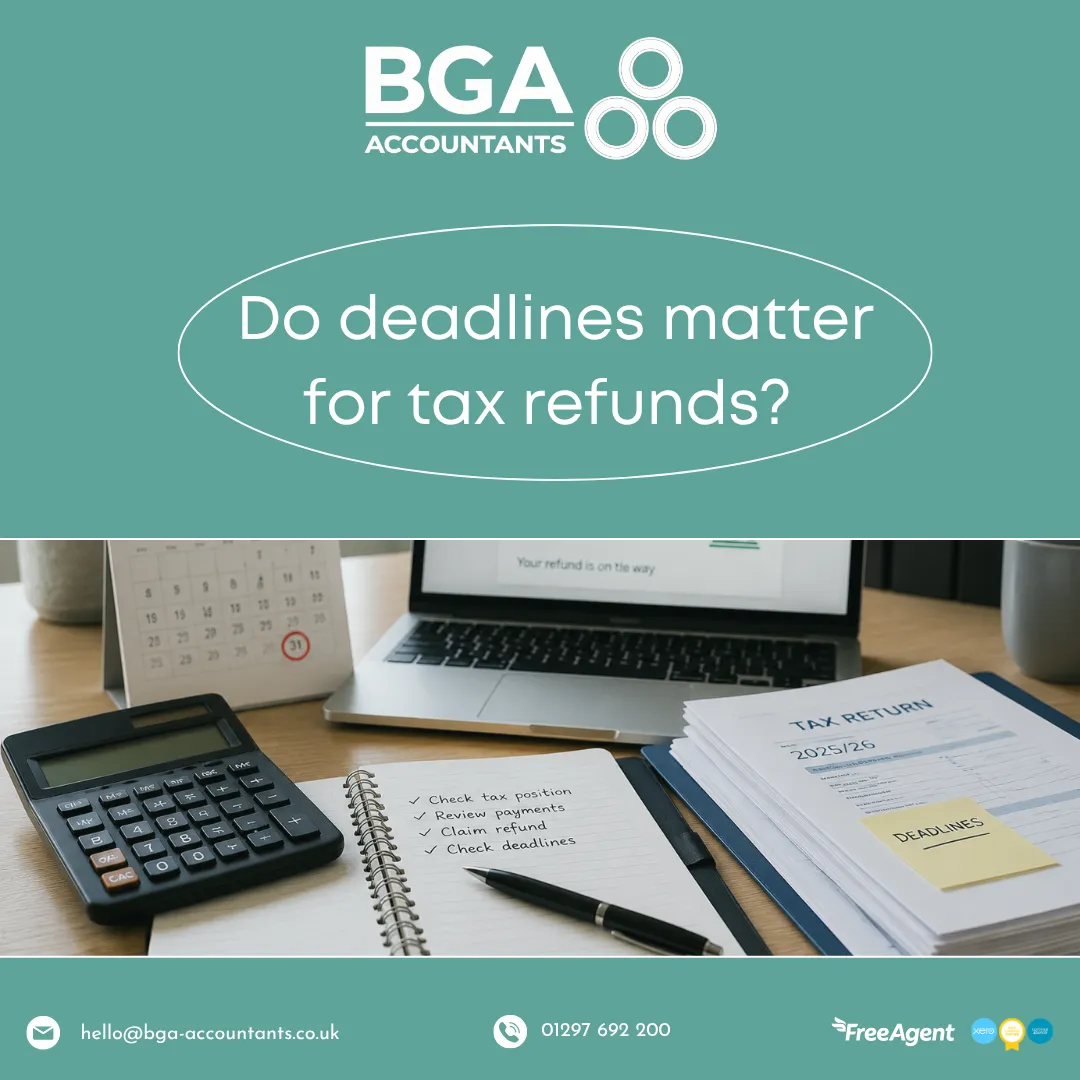
Do deadlines matter for tax refunds?
Not all taxpayers owe money – sometimes they are due a repayment. This may be for a number of reasons and the method by which that repayment is obtained variesdepending on which type of tax the repayment relates to. The rules also differ depending on whether the repayment arises from an amended return, a claim or another form of tax adjustment. Different taxes have different deadlines by which a refund can be claimed. However, missing that deadline need not mean the refund is lost forever.
PAYE repayment
Many taxpayers, particularly those whose income is fully or partly taxed under PAYE may not be aware that an overpayment has arisen until they receive a tax calculation from HMRC. For PAYE taxpayers, HMRC can reconcile the information it receives from employers, pension providers and benefits offices and calculate the tax position from that information. To reclaim, the taxpayer can claim online or via the HMRC app, through their personal tax account or by contacting HMRC direct. The refund will then be made via a cheque or the online bank transfer service. Note that HMRC only issues a simple assessment when the taxpayer owes tax.
Self-assessment
Should the taxpayer be subject to self-assessment and a refund is due once their tax return has been prepared, a claim should be made on that return. HMRC instructions state that if any tax is due within 45 days of the return being submitted, the refund will be deducted from any tax owed. However, some taxpayers find that the completion of the refund section of the return is not always actioned and the refund sits in the taxpayer’s account. The taxpayer then has the choice of either leaving the refund where it is or completing a claim online. Depending on the taxpayer’s circumstances, many decide to leave the refund where it is which will then be deducted from the next payment on account should the taxpayer be liable.
Where a taxpayer has overpaid but has not yet made a self-assessment return, they can recover the overpayment during the tax year, by making a claim to amend their payments on account.
Missing a deadline
Although the deadline for submitting a return is 31 January after the tax year end, should any amendment be required, including a claim for loss relief against general income (whether producing a repayment or not), an amendment can be made within 12 months of the normal filing date. However, HMRC strictly adheres to this deadline and another method of claiming must be used if more than 12 months have passed since the self assessment filing date.
Not every tax relief is obtained simply by claiming on a tax return. Some reliefs require a separate claim, with the general rule being four years from the end of the relevant tax year. However, some claims have shorter or otherwise specific periods, e.g. the deadline for a claim to carry back losses against the previous year’s profits is first anniversary of the normal 31 January self-assessment filing date for the loss-making year. Where a loss is stated in a company tax return and the return can no longer be amended, the loss becomes final.
Overpayment relief – A possible alternative
Where tax has been overpaid and the ‘general’ amendment or claim route is no longer available, overpayment relief may provide a possible alternative. The claim can be made to recover income tax, CGT, Class 4 NIC or corporation tax. However, as ever with tax, there are restrictions, notably that the claim must be made within four years after the end of the ‘relevant tax year or accounting period’ (tax year for non corporate repayments and accounting period for corporation tax overpayments).
Should the claim be as a result of a mistake made on the return, the ‘relevant tax year or accounting period’ is the one covered by that return. For any other tax overpayment, the ‘relevant tax year or accounting period’ is the one in which the tax was actually paid.
VAT
The four years ‘general’ deadline also applies to overpayments of output VAT. Depending on the amount (over or under £10,000), the taxpayer can either adjust the return for the period in which the over declaration was discovered or claim a refund by making an error correction notification.
Practical point
‘Overpayment relief’ should not be relied upon if a deadline is missed. It is not a concession; therefore, a claim must be carefully prepared.

The BGA Difference
Simple, Honest Advice — With No Surprises
We work on fixed monthly fees, with unlimited calls and meetings included — so you can ask questions anytime, without worrying about the cost.
Your first meeting and initial advice are always free.
We speak plain English, not accountancy jargon. You shouldn’t need a finance degree to understand your own numbers — and we’ll explain everything clearly so you feel confident, not confused.
We’ve seen it time and again: when clients understand their accounts and taxes, they make better decisions. That’s why we focus on accessible advice, regular check-ins, and smart tax planning throughout the year.
We're not the cheapest Accountant around and we don't want to be! We provide a reliable, quality service at a fair price.
Contact
Opening hours
Monday - Thursday : 9:00AM - 5PM

Helping you achieve financial success with expert guidance and personalised strategies.


© BGA Accountants. 2026. All Rights Reserved.
PRIVACY POLICY | SUPPORT | TERMS & CONDITION