Call us today on 01297 692 200 to find out how BGA Accountants can help you!


Blog
Latest Blog & Articles
Stay informed with expert financial insights! Explore our latest blogs on wealth management, retirement planning, and smart investment strategies. Empower your financial future with practical tips and expert advice.
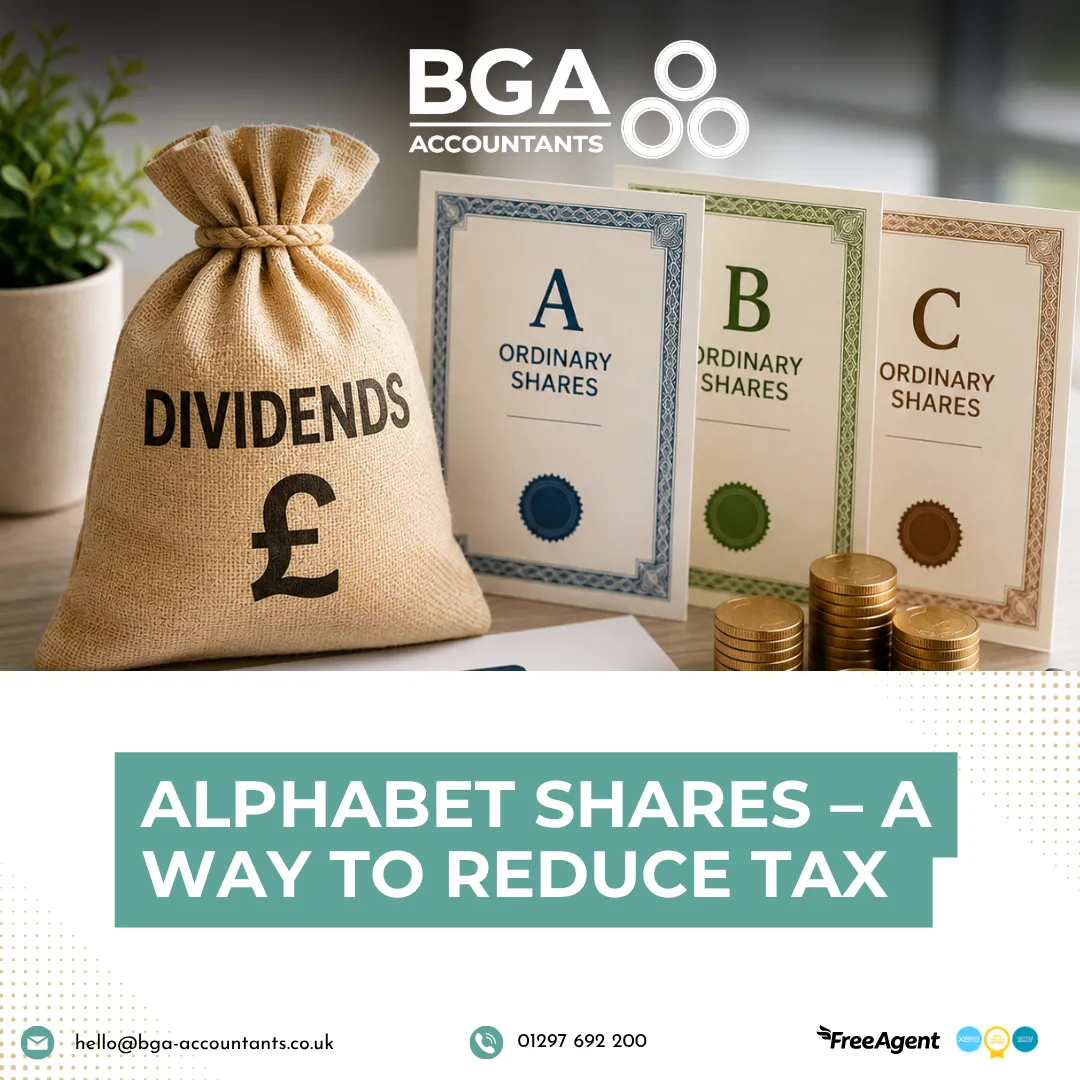
Alphabet shares – A way to reduce tax
When a company pays a dividend, all shareholders holding the same class of shares must receive dividends in proportion to their shareholdings. To pay dividends at different rates, a company must either issue different classes of shares with distinct dividend rights or vary the proportions held by shareholders. Alphabet shares are commonly used to provide such flexibility.
What are alphabet shares?
Alphabet shares are different classes of shares identified by letters, such as ‘A’ ordinary shares and ‘B’ ordinary shares. They allow dividends to be paid to one class of shareholder without requiring equal dividends to all shareholders. This can be particularly useful where shareholders are taxed at different rates, e.g., where one shareholder is a higher-rate taxpayer and another is a basic-rate taxpayer or non-taxpayer.
In addition to differing dividend rights, alphabet shares may allow different voting rights or other restrictions, such as redeemable or non-redeemable rights. However, where shares are intended to qualify for the spouse exemption under the settlements legislation, care should be taken to ensure the shares carry full ordinary share rights and are not substantially restricted. Otherwise, HMRC may argue that the recipient has not acquired true ownership but only a right to receive income and tax dividends on the original shareholder instead. Therefore, shareholders should retain genuine beneficial ownership of their shares, including rights to capital, voting and future growth, rather than holding shares solely to receive dividends.
‘Settlements’ legislation
The settlements legislation is designed to prevent income being diverted from one person to another for tax advantages while the original owner retains effective control or benefit. Dividends paid on certain classes of shares must represent a genuine return on investment rather than effectively being remuneration for services taxed as employment income under PAYE and NIC.
HMRC’s stance
HMRC can now more easily identify who owns shares in which companies through enhanced digital reporting, data matching and Companies House transparency reforms.
In addition, as from 6 April 2025, any person who was a director of a close company during the relevant tax year must include the name and registered number of the close company, the dividend amount received by the taxpayer and the percentage of the share capital owned in their personal self-assessment tax return. The intention of this additional declaration is to enable HMRC to identify cases where a director’s dividend income appears inconsistent with their shareholding as declared to Companies House or where income-shifting arrangements may exist and merit further review.
Family investment companies (FIC)
Alternative structures such as a FIC may be worth considering. A FIC is a private company set up to hold, invest and distribute family wealth.
The typical structure involves parents as both directors and shareholders, retaining voting control through a single share class. Children or grandchildren are allocated different share classes with limited or no voting rights but entitlement to dividends and capital growth. Care must be taken where parents provide funds for the children’s share subscriptions or where the dividend policy is structured to benefit the children at the expense of the parents.
Suggested action
Directors should be wary of creating alphabet shares immediately before declaring a dividend or after substantial reserves have accumulated, as HMRC may view this as evidence of income shifting.
Generally, dividends should be paid into an account beneficially owned by the shareholder concerned. Genuine joint accounts are usually acceptable.
If a future sale of the company is anticipated, shareholders should consider the qualifying conditions for Business Asset Disposal Relief. Any restrictions attached to alphabet shares may affect eligibility.

The BGA Difference
Simple, Honest Advice — With No Surprises
We work on fixed monthly fees, with unlimited calls and meetings included — so you can ask questions anytime, without worrying about the cost.
Your first meeting and initial advice are always free.
We speak plain English, not accountancy jargon. You shouldn’t need a finance degree to understand your own numbers — and we’ll explain everything clearly so you feel confident, not confused.
We’ve seen it time and again: when clients understand their accounts and taxes, they make better decisions. That’s why we focus on accessible advice, regular check-ins, and smart tax planning throughout the year.
We're not the cheapest Accountant around and we don't want to be! We provide a reliable, quality service at a fair price.
Contact
Opening hours
Monday - Thursday : 9:00AM - 5PM
Helping you achieve financial success with expert guidance and personalised strategies.

© BGA Accountants. 2026. All Rights Reserved.
PRIVACY POLICY | SUPPORT | TERMS & CONDITION