Call us today on 01297 692 200 to find out how BGA Accountants can help you!


Blog
Latest Blog & Articles
Stay informed with expert financial insights! Explore our latest blogs on wealth management, retirement planning, and smart investment strategies. Empower your financial future with practical tips and expert advice.
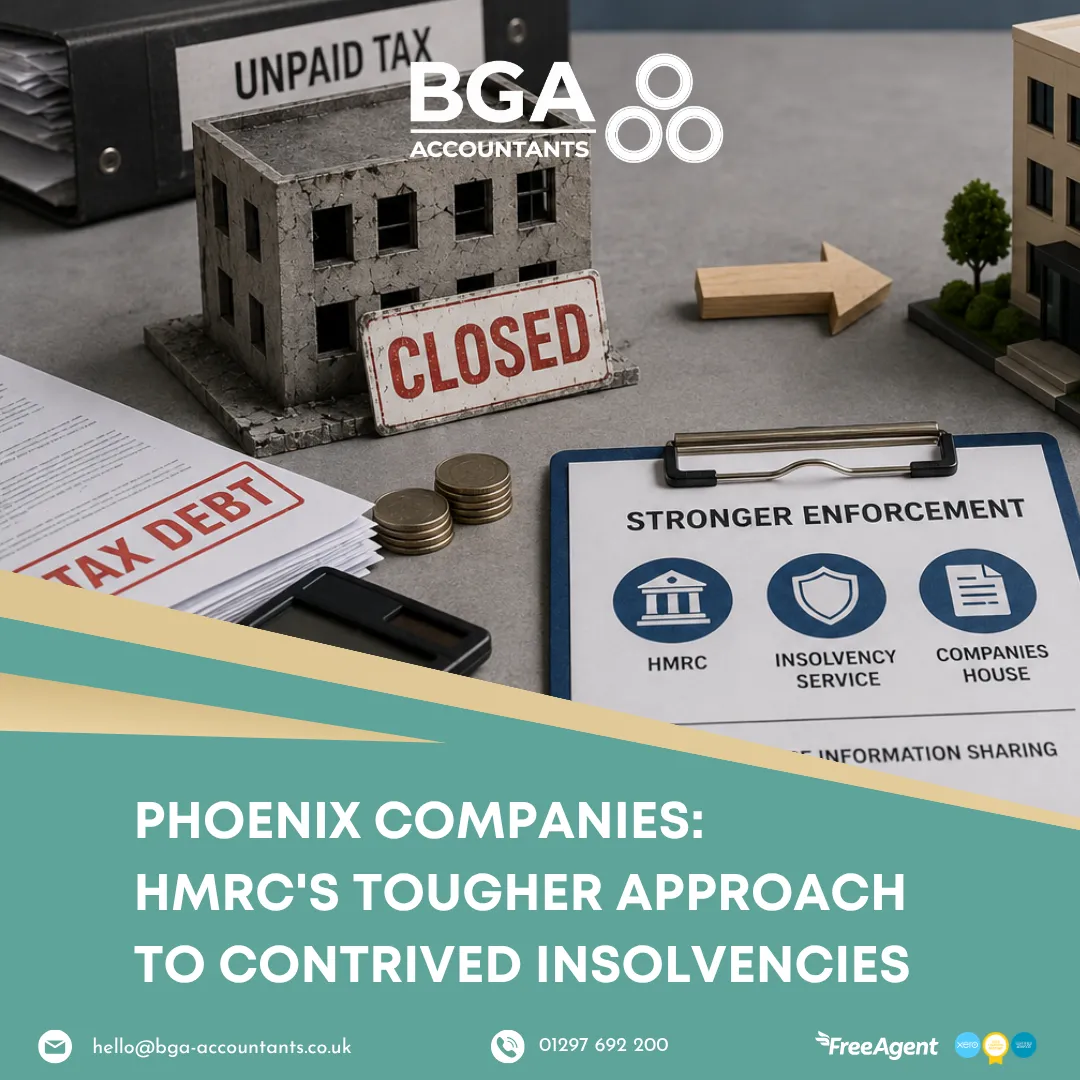
Phoenix companies: HMRC's tougher approach to contrived insolvencies
In November 2025, the government announced a joint strategy involving HMRC, the Insolvency Service and Companies House to crack down on what is termed ‘contrived insolvencies’ i.e.company closures engineered to avoid paying tax through the use of so-called ‘phoenix companies’. The measures signal a tougher approach to directors who repeatedly abandon companies with unpaid tax liabilities before starting near-identical businesses.
What is ‘phoenixing’?
Phoenixing is where a company’s owners close that company and then shortly afterwards begin trading through a new company carrying on substantially the same business, often with the same customers, assets and management. The old company's debts, including unpaid tax, remain behind while the business effectively continues in a new corporate vehicle. This practice is known as ‘phoenixism’, because the new company rises from the ashes of the old one.
While this method of incorporating companies is not automatically illegal (an owner is permitted to close a struggling business and start again), problems arise where insolvency is deliberately used to avoid paying creditors, particularly HMRC, or to obtain a tax advantage. HMRC is now looking to treat this as a priority target.
Closing a company can save tax
Company profits are normally extracted as dividends, subject to income tax at the shareholder's marginal dividend tax rate (currently up to 39.35%). However, if the company is formally wound up, the payout is usually treated as proceeds from selling shares, taxed under the capital gains tax (CGT) rules at lower tax rates, the highest being 24%.
Qualifying shareholders may also get business asset disposal relief (BADR), reducing the tax rate even further. Although BADR has become less generous at 18%, this tax rate is much lower than that applicable if the distribution is treated as income.
The difference in tax rates encourages some owners to close a company, take the proceeds as a capital gain at the lower rates, then start a near-identical company, turning what should be income into a gain.
The targeted anti-avoidance rule (TAAR)
To counter this practice, the TAAR permits HMRC to tax the liquidation proceeds as income instead of a capital gain if the winding up is undertaken mainly to obtain a tax advantage.
The rules apply where all the following conditions are met:
Condition A: the individual receiving the distribution had at least a 5% interest in the company immediately before the winding up;
Condition B: the company was a close company at any point in the two years ending with the start of the winding up;
Condition C: the individual receiving the distribution continues to carry on, or be involved with, the same trade or a trade similar to that of the wound-up company at any time within two years from the date of the distribution; and
Condition D: it is reasonable to assume that the main purpose, or one of the main purposes of the winding up is the avoidance or reduction of a charge to income tax.
HMRC considers both the circumstances at the time of liquidation and subsequently afterwards when deciding whether the rule applies.
Targeting directors
Normally, a limited company is responsible for its own tax debts, not its directors.However, HMRC can, in certain cases, make directors personally liable by issuing a Joint and Severable Liability Notice where HMRC believes there has been repeated tax avoidance, deliberate tax evasion or a pattern of ‘phoenixing’.
HMRC also intends to make greater use of its existing powers to require security deposits from businesses considered high risk. These deposits may cover future VAT, PAYE, NIC and other tax liabilities. Companies that continue trading after being required to provide security but fail to do so may commit a criminal offence.
Practical point
The latest strategy is aimed at directors who repeatedly leave unpaid tax behind through successive company failures. The three departments will share more information and target suspected abusive phoenix activity more effectively.

The BGA Difference
Simple, Honest Advice — With No Surprises
We work on fixed monthly fees, with unlimited calls and meetings included — so you can ask questions anytime, without worrying about the cost.
Your first meeting and initial advice are always free.
We speak plain English, not accountancy jargon. You shouldn’t need a finance degree to understand your own numbers — and we’ll explain everything clearly so you feel confident, not confused.
We’ve seen it time and again: when clients understand their accounts and taxes, they make better decisions. That’s why we focus on accessible advice, regular check-ins, and smart tax planning throughout the year.
We're not the cheapest Accountant around and we don't want to be! We provide a reliable, quality service at a fair price.
Contact
Opening hours
Monday - Thursday : 9:00AM - 5PM

Helping you achieve financial success with expert guidance and personalised strategies.


© BGA Accountants. 2026. All Rights Reserved.
PRIVACY POLICY | SUPPORT | TERMS & CONDITION